How to get around Mauritius: the practical guide
Mauritius is small, journeys are short, and there are three honest options. A road-tested read from the team.
Prices, opening hours and what a place accepts are our own notes, checked in August 2026. Rates move with the season, and small family-run places in Mauritius change their hours without announcing it anywhere, so treat these as a starting point rather than a timetable and call ahead for anything you are driving across the island for.
Mauritius is a small island. Roughly 65 kilometres top to bottom, 45 across, and the longest drive you will do in a normal week here is the one from the airport to your residence on the opposite coast. Most journeys between the places you actually want to be (your residence, the beach, dinner, a hike, the next residence) are 30 to 60 minutes. That changes the calculus on transport. You don't need a car for the whole stay; you don't need to plan logistics like you would in Sicily or Sri Lanka. You need an honest picture of three options, and a sense of which one to pick for which day.
The three options are: a driver, a hire car, or taxis and ride-hailing. Most guests we plan with end up using two of the three across a week. Below is what we'd recommend, with prices in euros at the current reference rate (Rs 50 to the euro, near enough for a planning conversation).
Option 1: driver-led days. This is what Friday recommends for most guests, most of the time. A driver with a sedan, English and French both spoken, costs roughly €120 to €220 per day depending on the route, the vehicle, and how far you're going. €120 for a south-west loop from Flic en Flac. €180 for a north-to-south traverse with a Black River Gorges detour. €220 for a long day that ends in Mahebourg or with a sunset stop somewhere far from where you started.
Why we recommend it. The driver knows the back roads, the parking spots, the lunch places that don't appear on Google. You can drink a glass of wine at lunch. You don't need to read signs in French while a roundabout figures itself out around you. The car turns up when it turns up, and the day ends when the day ends. The headspace it gives back is the entire point: you came here for a holiday, not for a driving puzzle.
What it isn't for. It isn't economical for the whole stay. Seven days of driver-led travel is around €800 to €1,400, and most guests don't want that. It also takes some of the spontaneity out (a hire car parked at the residence is there at 6pm if you decide to chase a sunset). And honestly, if you're a confident driver and you have a week, you will enjoy the freedom of doing some of it yourself.
Where it shines. A licensed private driver can suit the south-west loop, a group that wants several stops, or anyone uncomfortable with left-hand driving on narrow inland roads. Book and pay the provider directly after confirming the route, vehicle, insurance, inclusions, waiting time, price, and cancellation terms. See our south-west loop guide for planning.
Option 2: car hire. A small sedan from a reputable rental is €25 to €40 per day. An SUV or a 7-seater is €45 to €60. Pickup at SSR airport is straightforward; the counters open at 4am for the morning long-hauls and stay staffed for the late-night arrivals. Drop-off is the same routine in reverse. Always pre-book online (Sixt, Europcar, and the local operator ABC Car Rental are the three we trust); the airport-counter walk-up rates are 30 to 50 per cent higher and the cars are whatever is left.
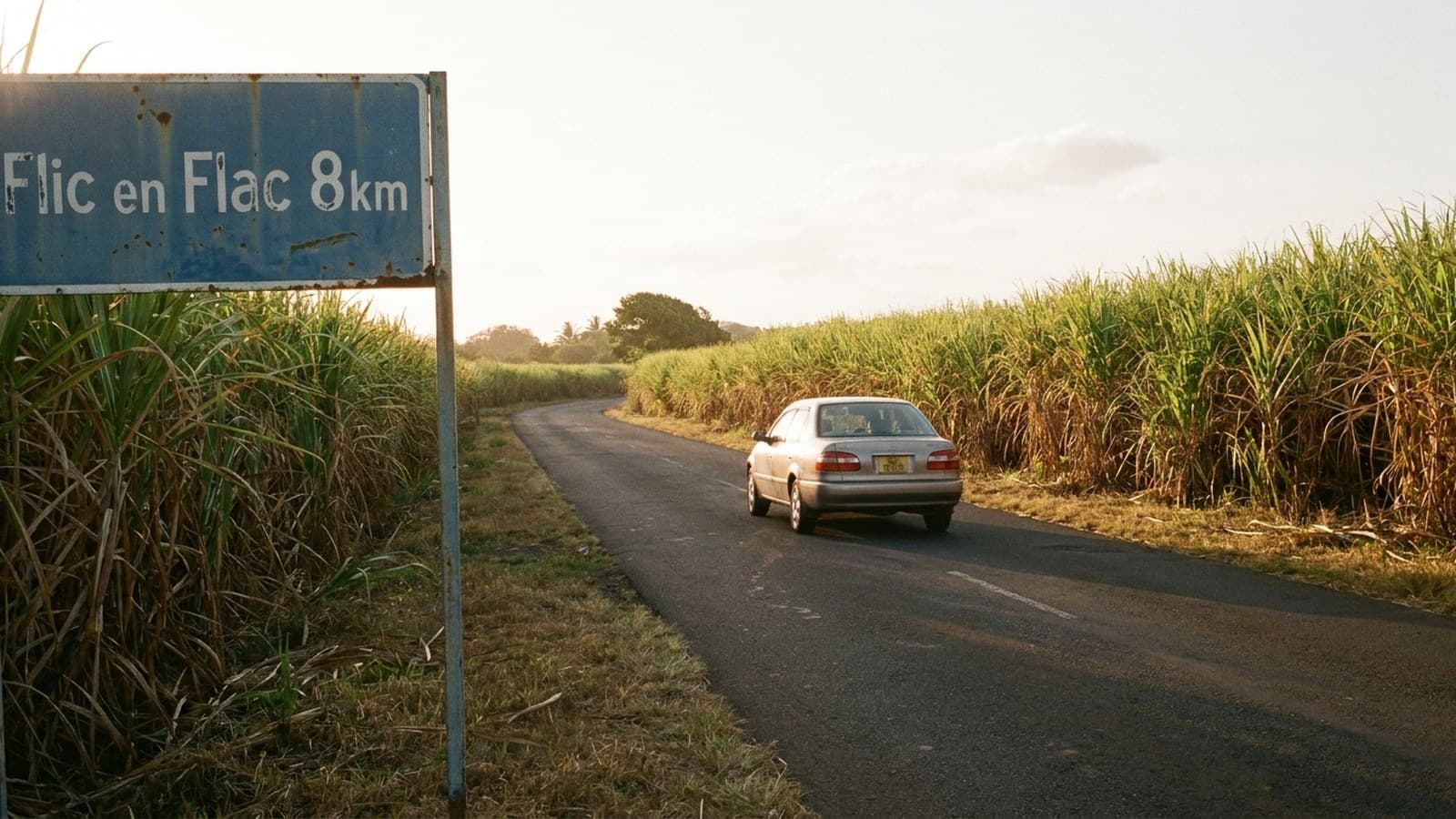
Driving in Mauritius. Left-hand side, like the UK. The main coastal roads and the M1 motorway are good, well-marked, and easy. The inland roads through the cane fields and the villages are narrow, winding, and often have someone walking, cycling, or selling pineapples on the shoulder. Roundabouts are flow-not-stop (give way to traffic already on the roundabout, but don't expect cars to brake hard if you hesitate). Motorways have automated CCTV speed cameras at consistent intervals, and the fines arrive at the rental company about three weeks later. Speed limits are 60 km/h in town, 80 on country roads, and 110 on the motorway, though sections of the motorway drop to 90 with no obvious reason.
The honest negatives. Parking in Grand Baie on a Saturday night is genuinely awful (we mean it). The south-west loop is more relaxing with a driver than at the wheel yourself, because the inland roads are slow and the Chamarel switchbacks are not the most enjoyable to drive after a glass of rum at lunch. Petrol stations close at 9pm in the residential areas, which catches people out on a Sunday night drive back from dinner. And the evening drive home from a long restaurant night is the one we'd rather you not do; a one-way Uber back from Tamarin to your residence is around €15.
Best for: families wanting full flexibility, stays of a week or more, beach-hopping plans where you'll want to be at three different lagoons in a week, and anyone comfortable enough at the wheel to enjoy rather than endure the drive.
Option 3: taxis, Uber, and Yugo. Uber is operational in Mauritius and the app works as you'd expect. The catch is driver supply: in Grand Baie and Flic en Flac in the evenings the wait is usually three to seven minutes, but outside those zones, and in the daytime in quieter areas, you can wait twenty minutes or get a 'no drivers available' notice. Yugo is the local PSV-licensed app; we use it as a backup when Uber returns nothing.
Taxis at hotels and residences are generally fair-fare, because they know they're competing with the apps now and the front-desk staff hear the complaints if they aren't. Taxis flagged on the road are a different conversation. Either ask the driver to 'run the meter' (a small percentage do, the rest pretend the meter is broken) or, more reliably, agree on the fare before you get in. A reasonable rule of thumb: €1 per kilometre on the meter, €15 to €20 for a 15-minute hop between coastal towns, €30 to €40 for a half-island trip. If the first price is dramatically higher than that, walk; the second taxi will quote half.
Best for: short evening trips to dinner, day-of decisions that didn't make it into a plan, one-way returns from a long lunch where you don't want to drive home, and anyone staying a few days where a car hire doesn't justify itself.
Buses. Cheap (Rs 30 to Rs 80, so under €2 anywhere on the island), frequent, and slow. Locals use them, budget travellers use them, and most guests skip them. The network is more comprehensive than visitors expect, with a hub at Port Louis and direct routes between most coastal towns. If you want the full map, the National Land Transport Authority publishes it (the route diagrams used to live at corporatemoms.intnet.mu, which is the kind of URL Mauritius does well). Worth it once, for the cultural experience of a bus from Flic en Flac to Curepipe through the cane fields, if you have a slow afternoon.
Bicycles, e-bikes, and scooters. Rental shops sit at the main beach towns (Flic en Flac, Grand Baie, Tamarin, and a handful at Le Morne). For short coastal hops between your residence and the beach, an e-bike is the small joy we'd recommend; €20 to €30 a day, easy on the legs, no parking problem, and the speed feels right for a coastal road that wasn't built for cars in the first place. Scooters we'd ask you to think twice about. The roads here are not kind to inexperienced riders, the lane discipline is more relaxed than European or North American norms, and an emergency hospital visit in Mauritius is a holiday-ending event. If you scooter at home regularly, you'll be fine; if you don't, hire a bike instead, or take an Uber.
Airport transfers. SSR International (the airport code is MRU, also called Plaisance locally) sits in the south-east, between Mahebourg and the sugar fields. From there it's roughly 70 minutes to Flic en Flac and 80 minutes to Grand Baie on the motorway. The east-coast and southern hotels are 15 to 45 minutes away; we don't operate east, so we plan around the two coasts we do.
Private transfer pricing. Historical indicative prices have been around €45 for a sedan to Flic en Flac and €55 to Grand Baie, with vans and minibuses costing more. Friday does not currently sell transfers through friday.mu. Book and pay a licensed operator directly, and confirm the live total, luggage capacity, child seats, meeting point, delay policy, and cancellation terms before travel.
Domestic flights and the small airfield. Most guests don't realise there's a second strip: Plaine Champagne (also called Plaine Corail when it serves Rodrigues), a small airfield that runs the Air Mauritius hop to Rodrigues, six days a week, around 90 minutes each way. It also handles the occasional charter to Réunion. There are no domestic Mauritius-to-Mauritius flights worth taking; the island is too small.
Practical fact sheet. A quick reference for the things people ask us by message at 11pm before flying out:
Petrol. The dominant network is Mol-Caltex, with Total and a few independents alongside. Premium unleaded sits around Rs 75 per litre (roughly €1.50). Stations close around 9pm in residential areas; the bigger 24-hour stations are on the motorway and in Port Louis. Don't run the tank to empty on a Sunday evening in the south.
Speed limits. 60 km/h in towns and villages, 80 on country roads, and 110 on the motorway, with sections dropping to 90 without much warning. CCTV speed cameras are active and consistent. Fines find rental cars; the renter takes the charge, and it typically arrives by email two to four weeks later.
Insurance. Full coverage is standard with all reputable rentals. Check the excess deductible: Rs 25,000 to Rs 50,000 (€500 to €1,000) is the normal range. Top-up insurance to zero out the excess is €5 to €10 per day; we usually take it for guests with kids in the car, and skip it on a short solo hire.
Driving licence. EU, UK, and most Commonwealth licences are accepted on their own. Other licences need an International Driving Permit alongside the home licence; pick one up before you fly. Minimum age is 23 with most rentals (some 21 with a young-driver fee).
Drink-drive. The legal limit is 0.05 BAC, enforced more strictly than visitors expect. Random breathalyser checks on Saturday and Sunday nights on the coastal road are common. A failed test is an instant licence suspension and a fine; we have seen it happen to a guest. If you're drinking at dinner, take an Uber or have a driver booked.
Roads to avoid. The Curepipe-to-Forest-Side stretch in heavy rain (poor drainage, the worst of the inland fog), and the airport-to-Mahebourg back road after dark (narrow, unlit, and busy with bus traffic). On both, take the motorway and the longer way around.
The practical recommendation. Pre-book a licensed transfer operator directly for airport arrival when predictability matters. Consider a private driver for a long multi-stop day, and hire a car separately if you want flexibility for beach-hopping and evening dinners. For shorter journeys, use a licensed taxi or currently available ride-hailing service and agree or confirm the price first.
Transport remains separate from a Friday residence booking. Verify live prices, licensing, insurance, vehicle capacity, child seats, and cancellation terms with the chosen provider before paying.